
Granite has been the default answer to "I want a natural stone worktop that can take a beating" for decades, and it has earned that position. It is hard, heat resistant, and it does not react to the acids that trouble marble.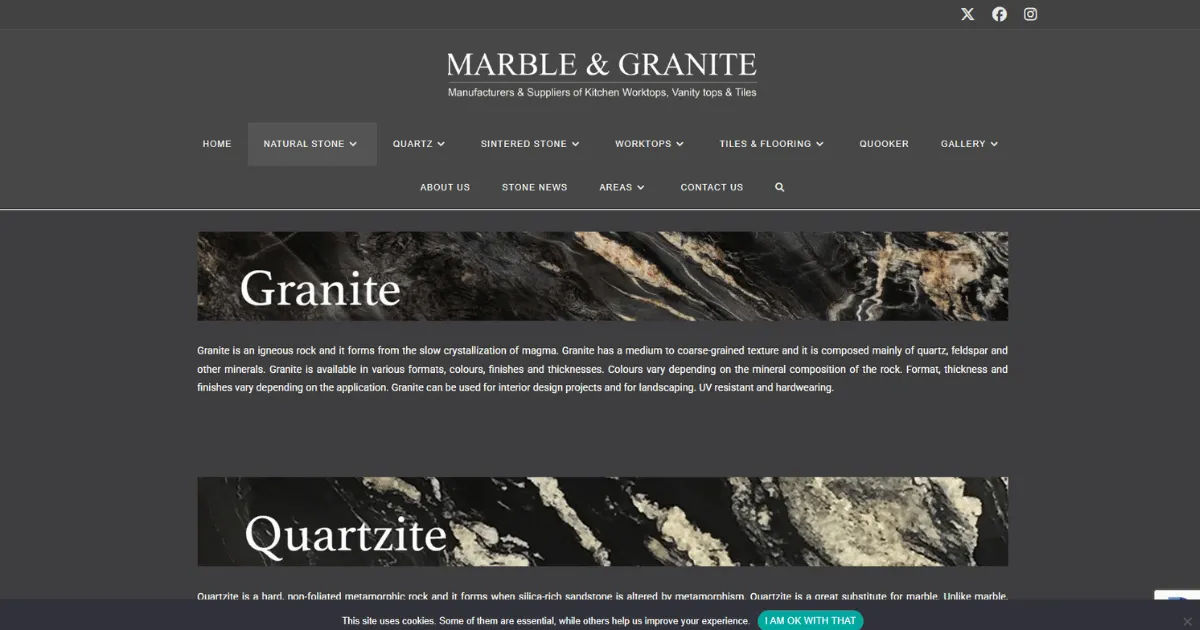
What it does have is a set of choices that materially affect the result, and most of them get decided quickly in a showroom without much explanation. This guide covers them properly.
What granite actually is
An igneous rock, formed from magma that cooled slowly deep underground. That slow cooling gives the crystals time to grow, which is why granite has a visible interlocking crystalline structure of quartz, feldspar and mica.
That structure is where the hardness comes from, and it is also why granite reads as speckled or granular rather than veined. The exception is the exotic granites, which have far more movement and can look closer to a marble or a quartzite.
Worth knowing: a good deal of stone sold as granite in the trade is technically something else, such as gabbro, gneiss or anorthosite. Commercially they are grouped together and they behave similarly, so it rarely matters practically, but it explains why two "granites" can look nothing alike.
Colour families and what they suit
Blacks. Nero Assoluto and similar absolute blacks give a dense, uniform surface with enormous visual weight. Excellent in contemporary kitchens and in bathrooms. They show dust and water marks more than mid tones do, and a honed finish shows fingerprints while polished does not.
Whites and light greys. Andromeda White, Kashmir White and similar. These bring granite's durability to a lighter scheme. Lighter granites are generally more porous than dark ones and benefit from more attentive sealing.
Mid greys and browns. The workhorse category. Forgiving, practical, and very good at hiding daily life.
Exotics. Blue Bahia, Rainforest, Van Gogh and similar. These are chosen as a feature, and they carry considerable price. Slab selection matters enormously here because the movement varies hugely between slabs from the same block.
Finishes
The finish changes the character of the stone more than most people expect.
Polished. The default. Maximum colour depth and reflectivity, easiest to wipe clean, and the most stain resistant because the surface is closed.
Honed. A matt, satin surface. Softer and more contemporary, and it hides scratches well. It shows fingerprints and oils more readily and generally needs sealing more attentively.
Leathered or brushed. A textured finish that follows the natural structure of the stone. Excellent for hiding marks, tactile, and increasingly popular on islands.
Flamed. A rough, riven surface produced with heat. Almost entirely an external finish, used for paving and steps.
Thickness and edge profiles
Standard granite worktop thicknesses are 20mm and 30mm. Thirty is the more substantial look and is generally the safer specification for a long unsupported run or a large island.
Edge profiles change the whole character:
- Pencil round or eased edge: simple, contemporary, and the most common
- Bullnose or half bullnose: softer, more traditional
- Bevelled: a crisp chamfer, quietly formal
- Ogee: a shaped classical profile for traditional kitchens
- Mitred edge: two pieces joined at 45 degrees so a 20mm slab reads as 40, 60 or 100mm. This is where a granite worktop starts to look expensive, and the cost is in the fabrication rather than the stone
- Waterfall: the material continues down the side of an island to the floor. Striking, and requires careful slab planning so the veining or pattern runs continuously
Sealing, and how much of a chore it really is
Granite is porous, though far less so than marble or limestone. It needs an impregnating sealer on installation and periodically afterwards.
How often depends on the stone and the sealer. A dense black granite with a modern impregnating sealer may go several years. A lighter, more porous granite in a busy kitchen may want annual attention.
The test is simple. Put a few drops of water on the surface and leave them for fifteen minutes. If the stone darkens where the water sat, it is absorbing and it is time to reseal. If the water beads and the stone is unchanged, the seal is working.
Resealing is a twenty minute job with a cloth and a bottle of sealer. It is not the burden it is sometimes made out to be.
What drives the price
Six factors, in roughly descending order of impact:
The stone itself. Common granites and exotic granites can differ by a factor of five or more per square metre.
Square metreage and layout. More area costs more, but so does a complicated layout with many cuts, returns and small pieces.
Edge detail. A mitred edge takes considerably more fabrication time than an eased edge.
Cut-outs. Sink, hob, tap holes and drainer grooves each take machine time. Undermount sinks require a polished internal edge, which costs more than a top-mount.
Splashbacks and upstands. Full-height splashbacks in matching stone add material and fabrication.
Access and installation. A first-floor kitchen, restricted parking or a long carry all add labour.
The process, briefly
- Initial measurements from your kitchen drawings, for a quotation
- Slab selection, ideally seeing the actual slabs
- Templating, once the units are fitted and level, using a laser or digital template
- Fabrication, typically ten to fourteen days
- Installation, usually a single day for an average kitchen
- Sealing and handover
The templating stage is the one that surprises people. It cannot happen until the base units are in and level, and the fabrication clock starts afterwards. Building that fortnight into your kitchen programme prevents most of the frustration.
Choosing where to buy
The things that separate a good supplier from a cheap one are whether you can see full slabs before committing, whether the templating is digital, whether the fabrication happens in-house, and whether the installers are the same people who cut it.
Our granite range sets out the stone we hold, and you are welcome to view full slabs rather than samples.
If you are searching for a marble and granite supplier near Hertford, our showroom and factory are at 136-138 Great North Road, Birchwood Industrial Estate, Hatfield AL9 5JN, a short drive away. Open Monday to Friday 8am to 5pm and Saturday 10am to 4pm for showroom visits, on 01992 535 038.